



Ethereum was the primary generalist blockchain to popularize Decentralize Finance (DeFI) by means of its use of good contracts. In flip, they created a wealthy ecosystem of dApps as net interfaces to the blockchain’s good contract, up to now accounting for 3,778 dApps throughout 6,730 good contracts. Such dApps have recreated just about all the monetary system – borrowing, lending, market making, exchanging – and at the moment are transferring towards blockchain gaming metaverses and NFTs.
But, this financial revolution transpired on fragile legs. Ethereum would possibly’ve amassed DeFi momentum with the very best variety of builders and dApps, however its Proof-of-Work basis makes it prohibitively costly to make use of.
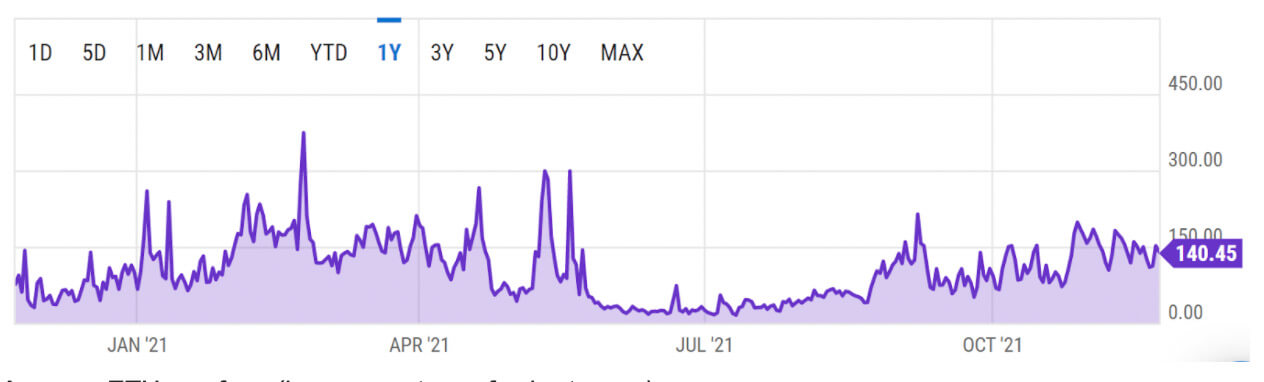
Opposite to the unique imaginative and prescient of crypto funds and transactions as frictionless and low-cost, Ethereum leaves for progress to be made. An estimated 71% of customers desire to pay with a debit or bank card, and for good cause: transactions are easy, with a point of safety, they’re usually quick (from the patron’s perspective – they swipe and go away the shop with their items), they usually’re free. Retailers pay a price, which is often beneath 3%.
Transactions on Ethereum are a lot completely different when in comparison with such conventional fee processors. Followers of Ethereum argue the answer lies within the ETH 2.0 improve, remodeling Ethereum to a Proof-of-Stake blockchain, the Beacon Chain. This will likely be Ethereum’s new spine, managing all shard chains and validators, as detailed within the ETH 2.0 improve roundup. On the finish of October, Ethereum accomplished the Altair improve, bringing it one step nearer to the Beacon Chain.
What Does the Altair Improve Carry?
After the Altair improve launched on October 27, 2021, ETH shortly thereafter eclipsed its all-time-high value (on the time) of over $4,500. With hopes infected, on this delicate transition interval, each Ethereum’s Proof-of-Work (PoW) and Proof-of-Stake (PoS) consensus work in parallel to one another.
As the largest Beacon Chain improve since December 2020, Altair is a check run to verify the projected 2022 Ethereum-Beacon Chain merger will likely be profitable. Listed here are a few of the Altair upgrades:
- Mild purchasers for simpler interplay with the community as a result of decrease computational and bandwidth prices than full nodes.
- Incentive restructuring which brings extra environment friendly bit yield to scale back complexity, inactivity leak quadratic perform that’s based mostly per validator, as a substitute of worldwide. The latter helps validators which have over 80% % participation charge.
- Bug fixes for validator rewards.
In principle, they need to all result in an Ethereum 2.0 that’s as quick and reasonably priced as different layer-1 competitor blockchains which have just lately risen in reputation. Within the meantime, Ethereum will proceed to depend on Layer 2 options to make it so. Nonetheless, there’s one other matter rising outdoors of Ethereum’s scalability. How decentralized is it actually?
Ethereum’s Decentralization Examined
If there are different good contract platforms with each negligible charges and quick transaction speeds, Ethereum’s strongsuit stays its extensive adoption and decentralization. On PoS blockchains, validators are equal to PoW’s miners, making the community run.
Merely put, a validator is software program working on node {hardware}. A validator’s job is to approve blockchain transactions and go this information to a node, which can then add it to the blockchain. In keeping with ethernodes.org, Ethereum is presently hosted by 2843 nodes, most of that are concentrated in Northern America and Europe.
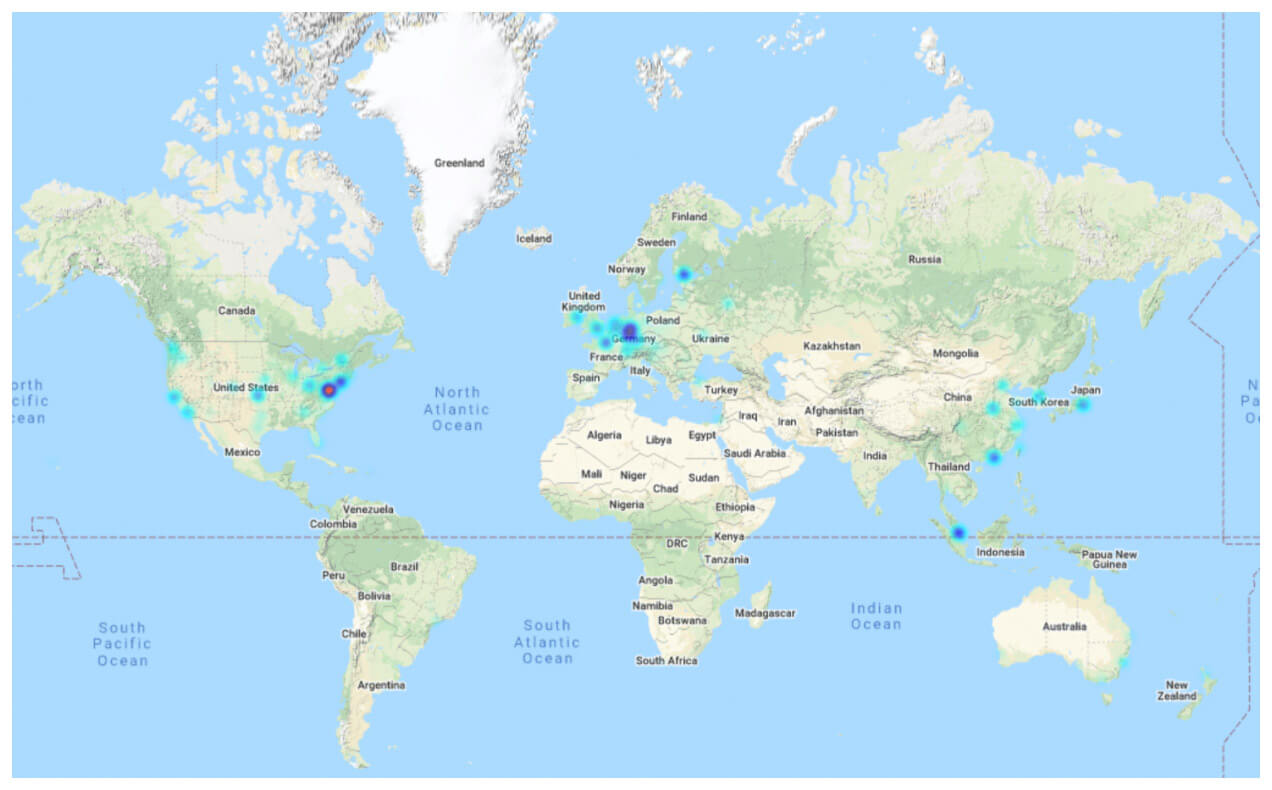
In percentages, the US holds 35.21%, Germany 15.20%, China 6.79%, Singapore 4.89%, Finland 3.87%, France 3.52%, Canada 2.92%, and the UK 2.85% Mixed with different international locations, North America and Europe make up practically 80% of Ethereum’s nodes.
As an instance this focus additional, Ethereum 2.0 nodes, on the Beacon Chain, are much more targeting the identical two continents.
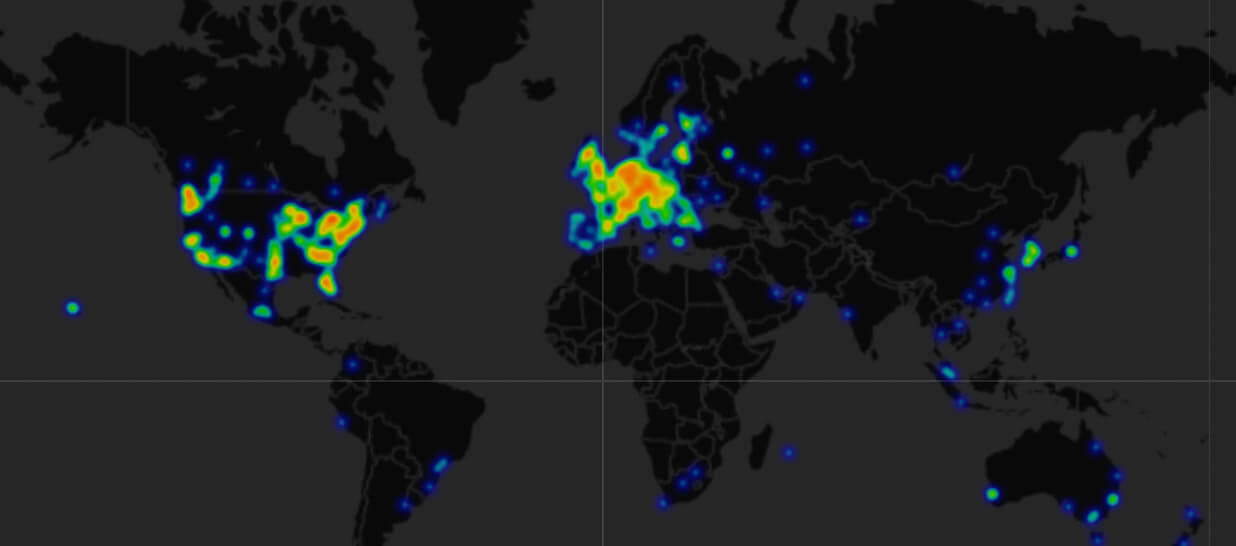
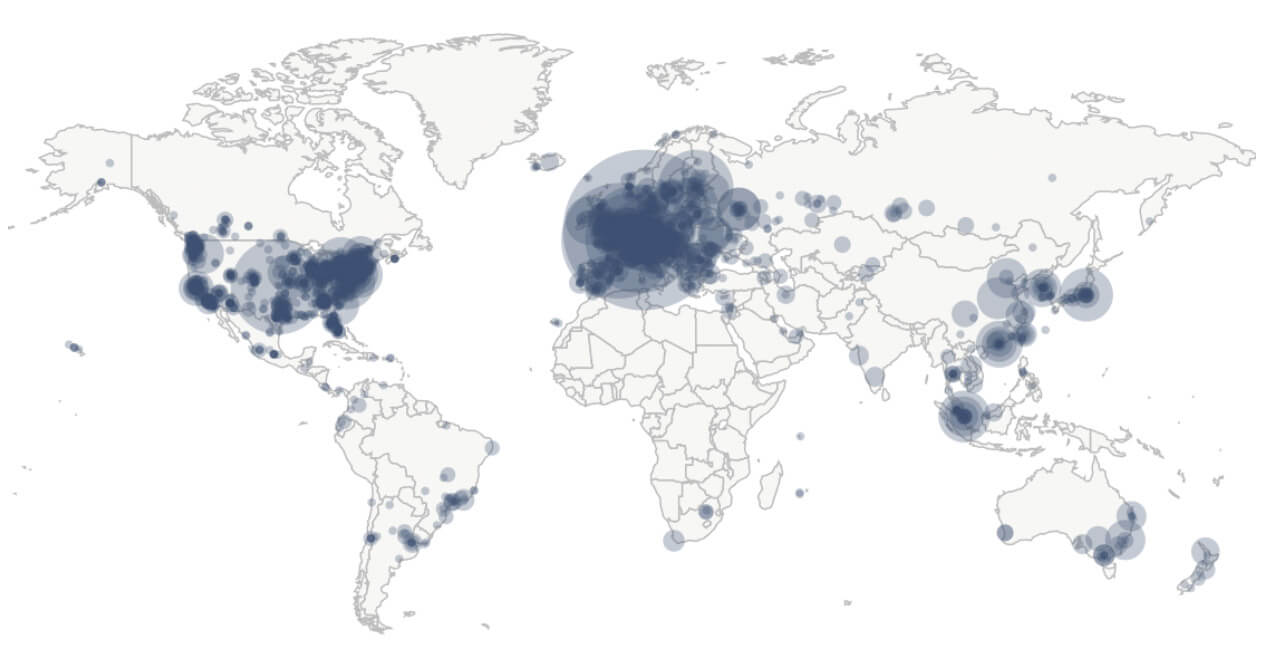
Out of 4,688 Beacon Chain nodes, over 1 / 4, 27.22% are within the US. Mixed collectively, the 2 continents of Europe and North America make up 81% of node distribution. When in comparison with Bitcoin, accounting for 13,239 nodes, the pattern is analogous, however there’s extra unfold towards South America and Asia.
Likewise, Solana, a wise contract various to Ethereum, additionally follows this focus pattern.
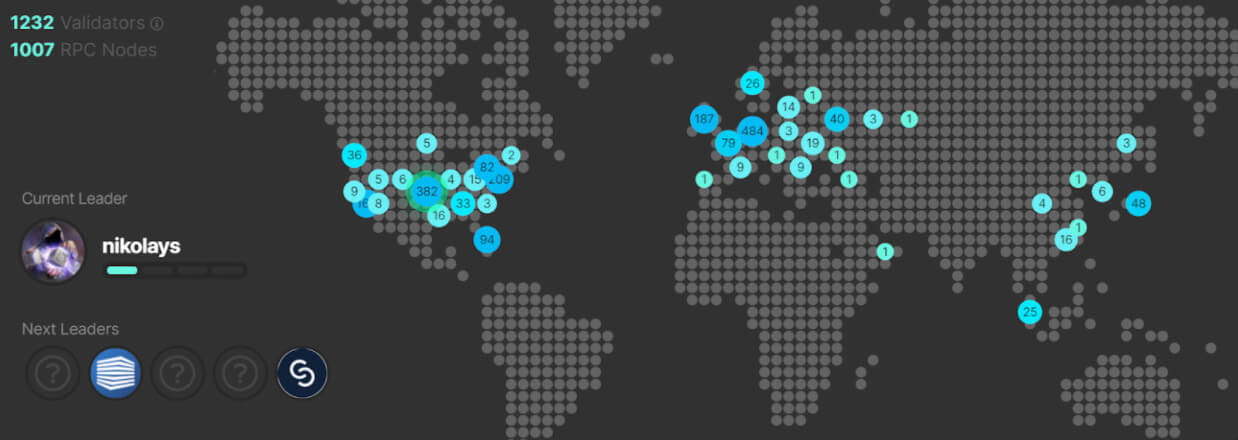
From these photos, we clearly see the divide between the World South and the World North. In different phrases, between the developed and growing nations. Even Ethereum, by far the most important good contract platform with over $100 billion TVL holds this hole.
The true query is, what are the elements which might be inflicting such a focus of nodes, and are they impeding world crypto adoption?
Why Is the World South Lagging?
When seen as a know-how, blockchain networks are ideally fitted to geographic areas which have both low inhabitants density or low infrastructural growth. Because of this the Kenyan M-Pesa was so profitable, spreading monetary providers to essentially the most unbanked areas of the world. Presently, these areas embody South and Central America the place 38% of the inhabitants are unbanked, and Africa the place 50% are unbanked.
With a easy SMS message on an old-gen cellphone, one may ship funds to different M-Pesa accounts, with solely mobile community protection required (that means, no information). A blockchain model of an analogous idea is Celo (CELO), a cellular platform that transforms telephones into digital banks for each crypto and fiat funds by means of Celo’s cUSD stablecoins.
Nonetheless, can blockchain know-how penetrate farther from that base stage into the World South? Sadly, there are extreme obstacles to beat first:
- Economically growing states might be weak to excessive ranges of corruption. The Corruption Perceptions Index (CPI) locations Sub-Saharan Africa at 32 out of 100, the lowest-performing rating globally. South America additionally usually scores low in keeping with CPI standards.
- In such situations, there’s much less capability to onboard new tech onto the inhabitants. As excessive ranges of corruption have a corrosive impact on individuals’s livelihoods, they’re extra centered on satisfying primary wants first.
- In flip, the expertise pool prepared to entertain the complexity of blockchain initiatives, together with node internet hosting, is proscribed from the onset.
Because of this outdoors assist is critical to jumpstart blockchain initiatives in these areas. Particularly, numerous UN businesses like UNICEF and UNDP (United Nations Growth Programme). Each allocate funds to grant blockchain initiatives in growing international locations, beginning way back to 2018.
Furthermore, by lagging in blockchain infrastructure, the World South leaves itself extensive open to potential financial sanctions, as we’ve got seen with Iran, Libya, Venezuela, and different nations. Can these nations observe the instance of Estonia, which in lower than 30 years transitioned right into a developed nation with a robust FinTech sector?
Provided that the governments of the World South concentrate on growing infrastructure first – steady electrical energy and cellular protection – forming the constructing blocks for e-Authorities.
Visitor put up by Shane Neagle from The Tokenist
Shane has been an lively supporter of the motion in the direction of decentralized finance since 2015. He has written a whole bunch of articles associated to developments surrounding digital securities – the combination of conventional monetary securities and distributed ledger know-how (DLT). He stays fascinated by the rising impression know-how has on economics – and on a regular basis life.
Be taught extra →
CryptoSlate E-newsletter
That includes a abstract of an important each day tales on the planet of crypto, DeFi, NFTs and extra.
Get an edge on the cryptoasset market
Entry extra crypto insights and context in each article as a paid member of CryptoSlate Edge.
On-chain evaluation
Value snapshots
Extra context
Be part of now for $19/month Discover all advantages