





Ethereum co-founder Vitalik Buterin revealed his imaginative and prescient for ETH 2.0 in a weblog submit this week titled “Endgame.”
He spoke of growing trustlessness and censorship resistance to ranges by his accepted requirements. To attain this, he laid out a “believable roadmap,” with a number of surprises, together with a proposed second-tier of staking utilizing fewer community assets.
The ultimate launch of ETH 2.0 is one thing of a working gag throughout the crypto group. Moreso each time fuel charges spike on elevated community exercise.
However given Ethereum’s sizeable community impact and the promise of decrease fuel charges, extra decentralization, and higher safety, it seems buyers, as an entire, are prepared to attend.
The endgame
To fulfill accepted requirements for trustlessness and censorship resistance associated to Ethereum 2.0, Buterin detailed a “believable roadmap” to attaining this.
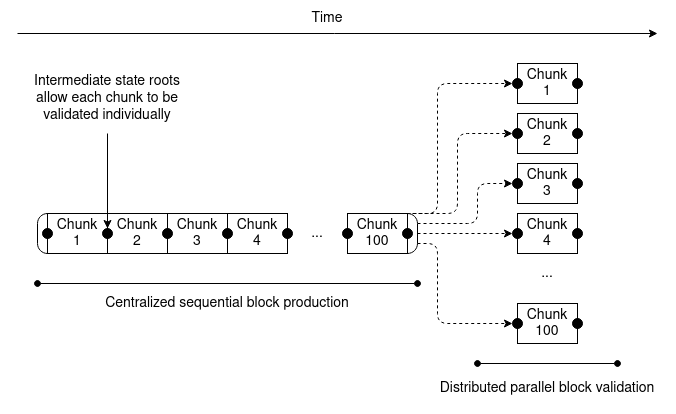
Beginning with a second staking tier that may decrease useful resource necessities for block validation. Buterin proposes transactions get cut up into (100) buckets, with a Merkle or Verkle tree root following every bucket.
As these “tree root” processes enable for large-scale information verification by somebody who solely has the tree’s root, the concept is to extend proof effectivity, thus scalability.
“The transactions in a block are cut up into 100 buckets, with a Merkle or Verkle tree state root after every bucket. Every second-tier staker will get randomly assigned to one of many buckets. A block is simply accepted when not less than 2/3 of the validators assigned to every bucket log off on it.”
He additionally talked about using roll-up/privateness expertise, corresponding to fraud proofs and zk-SNARKs, for an added layer of safety on high of the bucket system.
Ethereum Layer-2 platform Polygon is because of host the zk Summit this Thursday, wherein they plan to disclose a major announcement to do with zero-knowledge expertise.
Buterin sees worth in introducing information out there sampling (DAS). This primarily affords a light-weight model of the blockchain, which means block validation can occur with out protecting an entire file of all the blockchain.
Lastly, to enhance censorship resistance, Buterin proposes the creation of secondary transaction channels to deal with block validation on a distributed foundation.
On this setup, block manufacturing is centralized, however block validation is trustless and decentralized.
When is a finalized ETH 2.0 getting launched?
The part 0 Beaconchain rollout occurred over a yr in the past, on December 1, 2020. This laid the inspiration for Ethereum 2.0 and in addition launched staking.
The present part devs are engaged on is “the merge.” As Ethereum 1.0 and a couple of.0 are working in parallel, merging the 2 chains is important to take the improve ahead. Official estimates put the merge date at Q1 2022.
However, contemplating the delay in setting off the “issue time bomb,” some say June 2022 is a extra possible date.
The time bomb is a course of to make Ethereum mining progressively tougher till it turns into unprofitable to mine ETH. The thought is to regularly transition from a Proof-of-Work chain to a Proof-of-Stake chain.
The ultimate implementation is “Shard chains,” which refers to managing transaction load throughout 64 shard chains for improved scalability. The estimated date is given as “someday in 2022.”
CryptoSlate E-newsletter
That includes a abstract of an important each day tales on the earth of crypto, DeFi, NFTs and extra.
Get an edge on the cryptoasset market
Entry extra crypto insights and context in each article as a paid member of CryptoSlate Edge.
On-chain evaluation
Worth snapshots
Extra context
Be part of now for $19/month Discover all advantages