



A hole fill in shares is when a shares worth strikes within the aftermarket hours above or beneath the shut of the day prior to this after which trades again by the hole.
Intro
Most day merchants are aware of the elemental evaluation instruments generally utilized in figuring out which shares to commerce.
Elementary evaluation is the apply of evaluating various elements, together with an organization’s stability sheet, administration, strategic initiatives, client habits, and microeconomic indicators, to find out whether or not a inventory is priced appropriately primarily based on the intrinsic worth of an organization.
In lots of instances, merchants utilizing basic evaluation instruments try to forecast whether or not and when the worth of a inventory will transfer up or down primarily based on future development prospects, they usually make buying and selling selections accordingly.
Although basic evaluation instruments to get a variety of media consideration, many merchants use one other inventory evaluation to assist them make sensible selections.
As an alternative of analyzing the basics, these merchants depend on technical evaluation to forecast future costs of shares.
Technical evaluation is the method of predicting future worth actions primarily based on historic worth habits inside inventory charts.
Merchants who base their buying and selling selections on technical evaluation make the most of a large checklist of methods to resolve when to purchase or promote a inventory. One of many methods they make use of entails buying and selling hole fill shares or taking part in the hole.
Whereas the idea is surprisingly easy, profitable execution will be difficult. Nevertheless, some merchants have efficiently made large returns with gap-fill buying and selling technique.
On this article, we’ll clarify what gaps are, what forms of gaps exist and the that means of hole fill shares.
That means of Gaps in Inventory Market
A spot is an space on a chart the place the worth rises or falls swiftly with none buying and selling exercise in between. This phenomenon usually happens when there’s frantic shopping for or panic-filled sell-offs available in the market.
Gaps will be discovered on a bar or candlestick chart in any timeframe. Nevertheless, they’re extra generally witnessed on the each day chart since merchants analyze the data obtained after the closing bell and have a tendency to make use of it originally of the following buying and selling session.
A hole up signifies that the low of the present candlestick is larger in comparison with the excessive of the earlier candlestick. A hole down, however, signifies that the excessive of the present candlestick is decrease in comparison with the low of the earlier candlestick.
Beneath is a each day chart of Meta Platforms the place the inventory had an enormous hole down after a horrible earnings report:

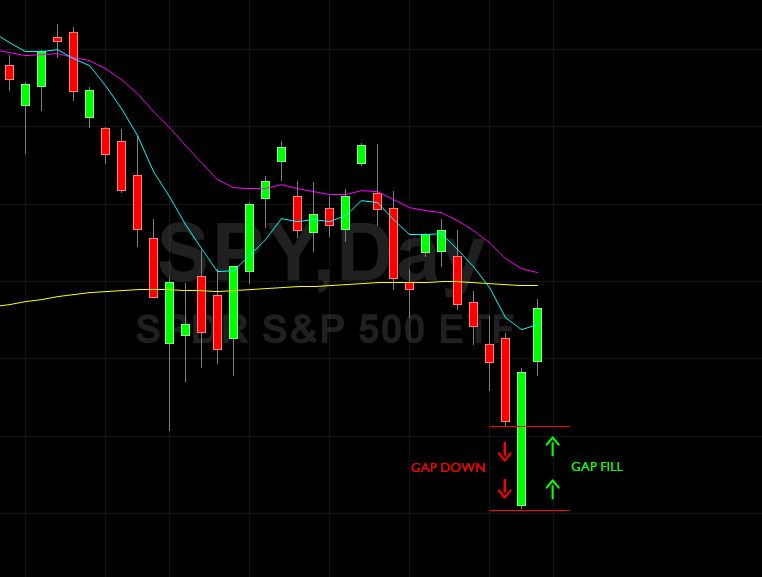
A spot fill in shares is critical as a result of the market is saying that the hole in worth doesn’t replicate market sentiment.
For instance, the market gapped down so much when Russia invaded Ukraine, nonetheless it was instantly purchased up when the market opened. This tells us the hole down was an overreaction as patrons jumped all around the cheaper costs.
What Causes a Inventory to Hole?
As said earlier, a niche happens when a inventory’s opening worth is completely different from the closing worth. Typically, gaps occur in intervals of low liquidity, when the market doesn’t have adequate patrons and sellers to cease surprising slumps and spikes in inventory worth.
Within the inventory market, gaps are normally seen after a buying and selling day ends and the market opens the next day once more.
Main occasions equivalent to company-related information and earnings studies can weigh in the marketplace sentiment after the closing bell, inflicting gaps in a inventory’s worth when buying and selling resumes the following day.
For instance, if an organization posts stronger-than-expected earnings after the closing bell, then the inventory is very more likely to hole up when the market opens the following day.
Forms of Gaps
Relying on the prevailing market situations, not all gaps are the identical. There are the 4 classes of gaps you’ll discover within the inventory market.
Frequent hole
A typical hole, additionally known as an space hole or a buying and selling hole, is generally brought on by regular market forces and doesn’t want a novel occasion.
Because the title implies, widespread gaps are non-eventful and common occurrences. Due to this fact, these gaps get crammed up as rapidly as they seem.
On a worth chart, widespread gaps seem as non-linear drop or leap from one level to the following.
Breakaway hole
A breakaway hole happens when the worth of a inventory gaps over a resistance or a help degree. This hole is much like a breakout sample, however the precise breakout happens within the type of a niche.
Breakaway gaps sign sturdy momentum and the worth of the inventory retains trending after the hole.
As well as, the larger the breakaway hole, the stronger the present development will likely be and the stronger the following candlestick will likely be.
Runaway hole/ Continuation hole
A runaway hole normally occurs in the midst of a robust uptrend or a downtrend. This hole represents surprising change in notion or curiosity a couple of inventory amongst merchants, adopted by a shift in demand because of a spike in shopping for or promoting.
When a runaway hole happens in an uptrend, it implies a shift in merchants’ curiosity within the inventory. If there are some merchants who might need been not noted in the course of the earlier uptrend, they could go on a shopping for spree as soon as they’ve observed {that a} retracement isn’t more likely to occur. This causes a sudden and vital spike within the commerce quantity and worth.
Alternatively, when a runaway hole seems in a downtrend, it represents the surplus liquidity available in the market. This will trigger a downtrend spiral the place panic might hit sellers and promote the shares, which could push the worth of the inventory decrease.
Exhaustion gaps
An exhaustion is a sort of hole that kinds close to the tip of a robust uptrend or downtrend, however in the other way of the underlying development. Exhaustion gaps sign that the development is starting to lose momentum, and {that a} reversal is about to occur.
These gaps are sometimes related to a surge in worth together with a surge in quantity. Exhaustion gaps point out {that a} inventory is making a remaining try at hitting a brand new excessive or low.
It’s fairly straightforward to mistake an exhaustion hole for a runaway hole. To distinguish between the 2, merchants evaluate each quantity and worth. If each quantity and worth enhance, that’s an exhaustion hole.
Buying and selling Hole Fill Shares
There may be an assumption amongst merchants and traders alike {that a} hole must be crammed, that means they count on the worth to return to the hole space at a later time.
Runaway and breakaway gaps are thought to have a decrease likelihood of being crammed, because of the assumption that the market occasion which made this kind of hole to kind possesses a robust directional momentum. Due to this fact, buying and selling a niche fill quantities to buying and selling in opposition to this momentum and the brand new shaped development.
In case you’re trying to commerce a “hole fill,” you would possibly wish to accomplish that when an exhaustion hole is shaped. Exhaustion gaps recommend the directional transfer is capitulating and doubtlessly reversing trigger, and assumes the next alternative to buying and selling a niche fill.
Backside Line
To be a profitable day dealer, one ought to be capable of spot and interpret gaps appropriately. Though gaps are widespread in each day inventory charts, they aren’t free from limitations.
An vital idea related to gaps is ‘filling’. This can be a idea the place the market readjusts to the inventory worth degree cancelling out the surprising change brought on by the hole.
Failure to determine a niche or react to it might trigger one to overlook a chance to get in or out of a commerce, that means gaps weigh tremendously on revenue or loss from a commerce.